


Day 1: Head to Tianhe Nan 1st Road First After Arriving in Guangzhou
I usually don’t pack my schedule on the first day, especially when arriving in Guangzhou in the afternoon. On the map, the various points in the Tianhe area don’t look far apart, but by the time you’ve dragged your luggage to the hotel, checked in, organized your things, washed up, and stepped out again, a good chunk of your stamina is already spent. If you arrange cross-district travel at this point, you’ll likely end up just “rushing” through the journey without the mental energy to actually observe the streets. Tianhe Nan 1st Road is perfect for the first night because it’s close enough, convenient enough, and steady enough. It’s not a single destination you must specifically visit, but rather a starting line that helps set the pace for your entire Citywalk trip.
I usually choose accommodation between Tiyu Xilu and Shipaiqiao, or within walking distance of these two metro exits. The advantage here isn’t the luxury of the hotels, but the time saved upon arrival. Arriving at the hotel in the afternoon, dropping off your bags, doing a quick tidy-up, resting for a bit, and then heading out to walk Tianhe Nan 1st Road feels very seamless. For a short stay, staying somewhere convenient is more important than staying somewhere cheap. If you stay in a remote area on the first day, every trip requires taking the metro, exiting, and finding the right exit, which easily eats up 20 to 30 minutes; this adds up significantly over 5 days.
- Try to keep your accommodation within a 10 to 15-minute walk of Tiyu Xilu or Shipaiqiao stations.
- I don’t recommend staying in far-flung areas on the first night; the money saved on room rates might not be worth the physical toll.
- Upon arrival, check the walking time from the hotel to Shipaiqiao, Tiyu Xilu, and Tianhe Nan 1st Road, as you’ll use these routes in the following days.
- Don’t spread your luggage out too much; you’ll usually return late on the first night, so the lower the effort to organize, the better.
My typical rhythm is checking in around 16:00 and heading out around 16:40. Those 40 minutes aren’t wasted; they allow the body to transition from “travel mode” back to “walking mode.” For those arriving by high-speed rail or flight, you might feel scattered and unfocused upon arrival. Even with a route planned, you might not be in the right headspace. Sit for a moment, wash your face, hydrate, and glance at the map. By the time you head out, you’ll feel much lighter.
| Time | My Typical Arrangement | Reason for the Arrangement |
|---|---|---|
| Around 16:00 | Check into the hotel | Settle luggage, IDs, and charging equipment |
| 16:10 to 16:30 | Quick organization, hydrate, review the route | Let the body transition from travel to walking mode |
| Around 16:40 | Head out toward Tianhe Nan 1st Road | Light is still sufficient for easy navigation |
| 17:00 to 18:30 | Walk the main street first, don’t rush into alleys | Establish a sense of direction without over-saturating information |
| 18:30 to 19:30 | Dinner by the street | Use a meal to stabilize the rhythm |
| After 19:30 | Walk a night route | Observe changes in lighting, crowds, and shop vibes |
I set the starting point near Shipaiqiao not because it’s the most iconic spot, but because entering Tianhe Nan 1st Road from here feels natural. Shipaiqiao, Tiyu Xilu, and Tianhe Nan are part of a continuous commercial and residential mixed zone. When visitors emerge from the metro, they quickly gain a visual sense of direction. The roads aren’t hard to identify, and the streetscape isn’t too empty. Transitioning from major roads to branch roads feels smooth rather than jarring. On Day 1, you want that feeling of “not being flustered.”
On this first night, I only walk the main street and don’t rush to explore every side alley. The reason is simple: when you first arrive, the most important thing isn’t seeing a lot, but understanding the relationship between your accommodation and the primary routes. Knowing which road the hotel is near, which intersection is more convenient, and which way to turn back after dinner is more practical than finding hidden routes immediately. You will repeatedly use these judgments starting from Day 2. Getting it right on the first night makes everything easier later.
I’ve always handled the first night on Tianhe Nan 1st Road conservatively. Observe the width of the main road, shop density, and pedestrian flow before deciding whether to turn into side streets. The benefit of this is that you won’t get lost before your energy levels are up, nor will you prematurely exhaust the most interesting content.
My first impression of Tianhe Nan 1st Road is often not that it’s “very busy,” but that it “doesn’t feel empty.” This “not empty” feeling isn’t about crowds; it’s about the constant content on both sides of the road. The main street has a high density of street-facing shops with continuous storefronts, and the street width is comfortable enough not to feel suffocating. You walk and observe, and your eyes naturally find things to see without having to look for them. For writing purposes, such streets are easier to describe in detail because the contrast between the main street and side alleys is very clear.
The side closer to the main road tends to be tidier, with storefronts that update faster and pedestrians who walk quicker. Once you turn inward, the street becomes quieter, and the sense of local life becomes more pronounced. I don’t rush to explore all these side streets on the first night, but I’ll intentionally stop at a few intersections to see the difference between the “inside” and “outside.” Sometimes, walking just 30 meters in reduces the noise level, more people are standing and chatting, and the rhythm of the street slows down. The charm of Tianhe lies in these rapid transitions.
- The main street is best for Day 1 as it’s easy to walk and hard to get lost.
- Side streets should only be briefly glanced at, not explored deeply on the first night.
- Stand at intersections for a moment to observe the flow of people and shop vibes before deciding whether to enter.
- The focus of the first night is “getting to know the neighborhood,” not “hunting for content.”
I usually schedule dinner between 18:30 and 19:30, which is better than eating at 17:00. If you eat too early, the street’s evening vibe hasn’t fully emerged; eat too late, and you might run into a denser crowd. On the first night, I don’t chase trendy spots or go far out of my way. I care about three things: proximity to the main line, being able to sit comfortably, and being able to continue walking afterward. Dinner on Day 1 isn’t a “task,” but a rhythm transition point. After walking for over an hour, sitting down allows you to stabilize, making the subsequent night walk feel better.
I personally value “observation seats” by the street. The food doesn’t have to be extraordinary, but it’s great if you can see the street. The most valuable information on the first night isn’t in the menu, but outside. You’ll slowly see commuters, students, local residents, and young people looking for food all mixed together—this diverse crowd speaks volumes about the street’s true state. Purely tourist streets often have a singular demographic, but Tianhe Nan 1st Road isn’t like that; it feels like the city’s daily life is running itself.
| Dinner Selection Logic | What I Prioritize |
|---|---|
| Distance | Within a 3 to 8-minute walk of the Tianhe Nan 1st Road main line |
| Rhythm | Able to continue walking afterward without needing a detour |
| Environment | Stable seating, preferably not too noisy |
| Cost | Kept within a reasonable range for the first night to save budget |
| Goal | Rest, recharge, and continue observing the nighttime neighborhood |
In terms of expenses, Day 1 usually isn’t very high. There are no tickets, no long-distance transport, and no need to arrange many activities. The primary expenses are accommodation, dinner, drinks, and a few convenience store supplies. For a short stay, this is a friendly start that avoids blowing the budget early on. I typically keep my first-night city spending within a steady range, saving money for the longer walking routes in the following days.
If you can figure out “how to get from the hotel to the main line, how long it takes, which section is smoothest, and where is the best dinner spot” on the first night, the following days will be much easier. Citywalk isn’t afraid of high content; it’s afraid of constant back-and-forth backtracking.
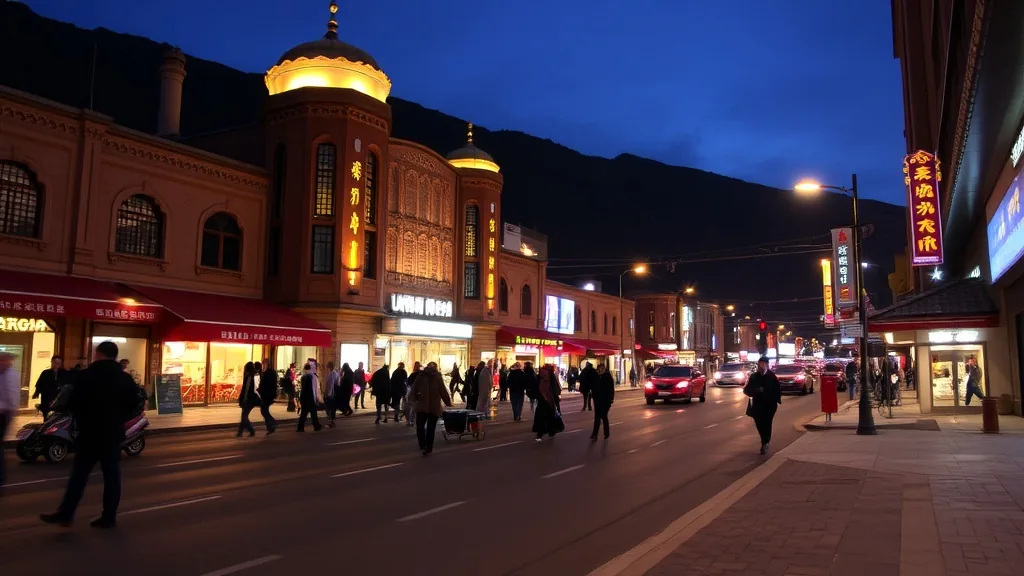
When I continue walking after 19:30, I’m not looking at the route itself, but at how the street changes at night. Tianhe Nan 1st Road has two different rhythms during the day and night. After dark, the lights on the main street reorganize the shops and pavement. A section of the road that seemed ordinary during the day might suddenly look much more appealing at night. Especially when people are sitting outside eating, window shopping, or waiting at corners, the street truly comes alive.
I intentionally slow down during this time. Not for photos, but to judge whether the street is worth exploring further the next day. What do I look for? Generally four things: first, is the crowd concentrated in just a few spots; second, does it suddenly become empty when leaving the main road; third, are many people sitting along the street; and fourth, is the lighting of the shops continuous. If all four points hold true, it means the street isn’t just walkable during the day, but has content at night as well.
- Nighttime is better for observing the overall state of the main street, not for deep diving on the first night.
- Around 20:00, the flow of people and lighting are usually at their peak.
- If a section becomes noticeably empty, feel free to turn back; don’t force it.
- The point of the first night walk is to decide “is it worth coming back tomorrow.”
Regarding accommodation, I still suggest staying between Tiyu Xilu and Shipaiqiao, not for the fame but for the walking logic. While Tianhe Nan 1st Road, Tiyu Xi Hengjie, and Liede Village aren’t far apart, reducing even one backtrack over a 5-day trip makes a huge difference. Especially when you first arrive in Guangzhou, the last thing you want is for everything to be far away, spending your entire evening on transfers.
When staying in such a location, I usually note three times: how long to Shipaiqiao, how long to Tiyu Xilu, and how long to the entrance of Tianhe Nan 1st Road. Remembering these three durations makes every departure much clearer. For example, if your energy is low at night, walk the shortest section; if you’re feeling good, visit an extra intersection. It seems like just a few minutes of walking, but it’s very useful for real-world itineraries.
| Judgment from Accommodation | Practical Significance |
|---|---|
| Around 10-minute walk to Shipaiqiao | Easy entry into the main line on Day 1 |
| 10 to 15-minute walk to Tiyu Xilu | Smoother route transitions on Days 2 and 3 |
| No transfers needed when returning to the hotel at night | Most friendly for 5 consecutive days of walking |
| High density of convenience stores and dining nearby | Returning late is effortless |
If I were to write about Day 1, I wouldn’t describe it as “just adapting.” That phrase lacks information. A more accurate way to put it is: after arriving in the afternoon, check into the Tiyu Xilu or Shipaiqiao area, rest briefly, then enter Tianhe Nan 1st Road from the Shipaiqiao direction. Walk the main street first without rushing into side alleys; stabilize the rhythm with dinner near the main line, and continue exploring the night streetscape after the meal. This way, readers can apply it immediately and understand why it’s done this way.
Truly useful experience isn’t about “what’s the hottest spot,” but how to handle the relationship between stamina, routes, and accommodation on the first day. Tianhe Nan 1st Road is a great opener not because of its fame, but its stability. it ensures you aren’t pushed around by the city’s pace nor left feeling empty due to lack of information. As long as you smooth out the main road, intersections, dinner spots, and directions back to the hotel on the first night, the rest of the days will be much easier.
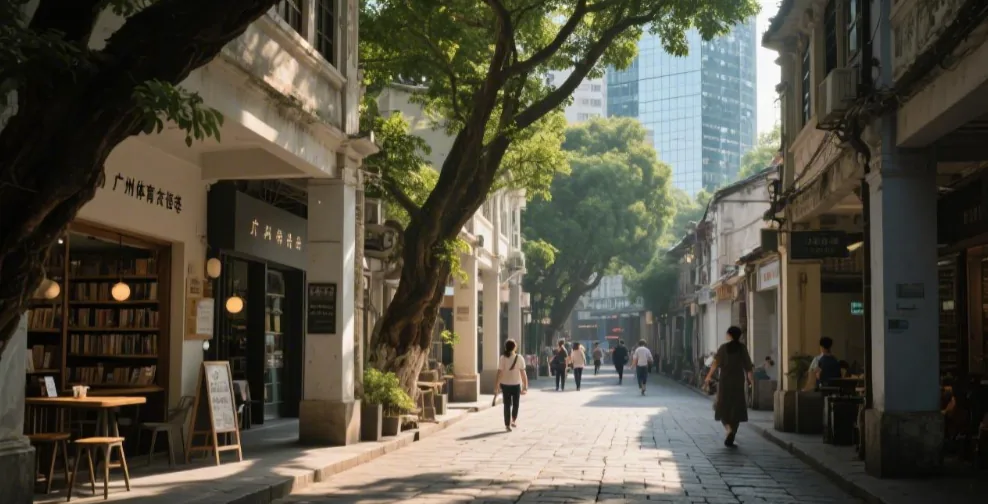
Day 2: Full Version of the Slow Stroll on Tianhe Nan 1st Road
On Day 2, I’ll dedicate the entire day to Tianhe Nan 1st Road, no longer just familiarizing myself with the route like on Day 1. The first night was more of a trial run focused on the geographical layout; on Day 2, I truly begin to look at the internal structure of the neighborhood. Tianhe Nan 1st Road is suitable for a detailed daytime walk for practical reasons. At night, you’re easily carried away by storefronts, lights, and crowds, remembering only the buzz; during the day, you can see how this street actually grew—how the main street connects to the side alleys, how residential and commercial spaces mix, which sections serve local life, and which lean toward outside consumption.
I usually start from the perimeter of Parc Central, rather than diving into the narrowest alleys immediately. this order is useful because the road scale around Parc Central is more complete and the sense of direction is stronger, making it a good opening for Day 2. Walking along the edge of the business district before slowly cutting into the east and middle sections of Tianhe Nan 1st Road helps the mind focus. For the first hour, I won’t rush to take photos or look at navigation; I’ll smooth out the main line first. Once that’s done, entering the side alleys won’t feel disorganized.
- I set the departure time around 09:30, not dragging it until noon.
- Start by sticking to the main street to recognize several intersections.
- The east section is good for seeing the neighborhood’s skeleton; the middle section is good for street-side vibes.
- Don’t wander into side streets randomly; get a clear sense of the main direction first.
| Time | Route | What I Focus On |
|---|---|---|
| 09:30 to 11:00 | Parc Central Perimeter → Tianhe Nan 1st Road (East) | Street undulations, shop turnover speed, transition from commercial to residential |
| 11:00 to 12:30 | Tianhe Nan 1st Road (Middle) | Daytime crowds, distribution of rest points, shop density |
| 12:30 to 14:00 | Lunch and rest nearby | No rushing; save your feet and attention for the afternoon |
| 14:00 to 16:30 | Side streets and Liuyun area perimeter | Sense of residency vs commerce, switching between quiet and busy |
| 16:30 to 18:30 | Wrap up near Tiyu East Road | Rhythm contrast between major roads and small streets |
The value of the Parc Central perimeter isn’t its uniqueness, but its ability to get you into the “zone.” Standing there, you see the tidier, more modern side of the area—wider roads, newer storefronts, and faster-walking pedestrians. Switching into Tianhe Nan 1st Road, the pace slows, and the street’s “expressions” multiply. This process is clearer during the day than at night. Darkness and lights can blur boundaries, but the day reveals them accurately.
In the east section, I notice the speed of shop turnover. Some parts of Tianhe Nan 1st Road look uniform at a glance, but closer inspection reveals different storefront styles, ages of decoration, and business types. This shows the street didn’t appear all at once but is constantly changing. For tourists, the street isn’t monotonous; for writers, there’s content to describe beyond just “good for shopping.”
When walking the east section of Tianhe Nan 1st Road, I don’t rush to the end. I stop every so often. Not for rest, but to see how the streets connect. Whether the main street feels smooth and if side streets cut in abruptly or transition gradually—these differences affect the entire route experience.
After 11:00, I move my focus to the middle section. It’s better than the east for seeing how the area “truly functions during the day.” As the morning rush fades, the crowd transitions from commuting to lingering, and the street rhythm stabilizes. You’ll see office workers getting coffee, people running errands, and others slowly picking a place to sit. This is a great time to observe the density of small shops because their daytime functions are clearer without the light effects of the night.
What I love about the middle section of Tianhe Nan 1st Road is that it doesn’t put all its content on the front. Looking at the main street, it just feels comfortable; but a glance sideways reveals many small roads extending inward. Some side streets lead to more food and shops, while others lead deeper into local daily life. This layered feeling is the most valuable part of Tianhe Nan 1st Road. It’s not about being ancient or trendy, but about having depth.
- The middle section is for slow walking, not for rushing through.
- Look at the spacing between shops and storefront changes; these are clearer during the day.
- Sit for a while where there are seats; it’s easier to see the flow of people while stationary.
- If you see an interesting side street, you don’t have to walk to the end; a shallow entry and exit saves stamina.
I won’t force myself to keep walking during the noon hour. I leave 12:30 to 14:00 for lunch and rest. The noon heat in Guangzhou has a significant impact on walking, especially in Tianhe with its buildings, reflections, and heat-retaining pavement. Walking non-stop after noon will cause your afternoon energy to drop. Day 2 is a full-day route, unlike Day 1’s 2-3 hours, so you must leave room for recovery.
For lunch, I choose a place near the main line that’s comfortable and has stable service, without making a huge detour. The focus of Day 2 isn’t a food tour, but maintaining the continuity of street observation. Lunch acts as an adjustment. The morning was for the street skeleton, the afternoon is for the interior; lunch sits in the middle to stabilize the rhythm.
| How I Choose My Noon Break | Reason |
|---|---|
| Near the Tianhe Nan 1st Road main line | Don’t have to find your bearings again after eating |
| Can sit comfortably for 40 mins to 1 hour | Essential stamina for the afternoon walk |
| Moderate price per person | There will be other expenses for drinks and dinner on Day 2 |
| No long queues | Save time for walking, not waiting |
After 14:00, I officially turn my attention to the side streets and the Liuyun area perimeter. This is where Day 2 truly gets detailed. The main street gives you a “smooth” line, but the side streets provide a “living” surface. The feeling of being 3 minutes into a side street vs. 8 minutes in is very different. The first 3 minutes still carry the brightness and flow of the main street; after 8 minutes, it feels more like a local residential zone—noise drops, and walking speed slows.
The reason the Liuyun area is worth writing about is that it retains a very typical sense of alley life behind a busy business district. You’ll find that while the outside might be commercialized, turning in reveals residential buildings, smaller shops, people sitting at doors, and parked cars—this “unpackaged” part is actually more interesting. It doesn’t rely on big attractions but on continuous details.
In the side streets, I often don’t rush to the end. If I see a street I like, I walk in a short distance to see if there’s more content or if it’s just for a shallow look. If the rhythm becomes quiet, I slow down; if it’s just a pass-through alley, I return to the main line to save my legs.
This section also has a practical advantage: high tolerance for error. The street connections around Tianhe Nan 1st Road are natural, making it hard to get too far off track. For first-time visitors to Guangzhou, this is important. You can’t plan every step, so a comfortable route should allow for spontaneous changes without panic. Tianhe Nan 1st Road is like that. If you feel like taking a different road, you can usually loop back without hitting a dead end.
I rarely feel “lost” when walking here. Even if I change direction, I’m just moving from one street with content to another. This is a rare experience. In many cities, leaving a main business street means things suddenly become empty or purely residential, and the content disappears. But near Tianhe Nan 1st Road, it unfolds in layers—the main street has its rhythm, the side streets have their density, and they all connect.
After 16:30, I gradually wrap up toward the Tiyu East Road area. This time is perfect for seeing the “contrast between the main road and small streets.” As the sun begins to set, building shadows divide the road into bright and shaded sections, creating visual layers. What you saw as structure in the morning becomes expression now. People start sitting outside shops, street-side seats fill up, and the street noise rises without reaching the chaos of the evening rush.
I love this time of day because it’s the easiest to write about. You don’t have to say “the vibe is good”; just describe the time, light, crowds, and street-side changes. For example, walking toward Tiyu East Road after 16:30, one side of the street is shaded by buildings while the other catches the setting sun. Commuters appear, street seats fill up, and the noise is there, but the road isn’t blocked. This is more useful for readers than vague adjectives.
- The late afternoon is for wrapping up, not starting new routes.
- Sit for a while during this time to watch how the crowd changes.
- If you plan to have dinner later, don’t walk your legs off now.
- Tiyu East Road is good for a “main road perspective” ending, not for deep alley dives.
In terms of expenses, Day 2 is usually higher than Day 1 but not excessively so. The difference is mainly in the increased need for supplies during the day—longer walking time means more spending on water, drinks, and temporary breaks. I break down expenses rather than lumping them into a single “daily total,” making it easier to judge what was necessary and what was spontaneous.
| Typical Day 2 Expenses | Approximate Range |
|---|---|
| Metro or short-distance transport | 10 to 20 RMB |
| Lunch | 40 to 90 RMB |
| Afternoon drinks and supplies | 20 to 50 RMB |
| Dinner | 60 to 120 RMB |
| Spontaneous spending | Around 30 RMB |
Slowly strolling Tianhe Nan 1st Road on Day 2 isn’t about “hitting certain spots,” but about walking out the street relationships of the area during the day. Why the main street is smooth, why side streets have layers, why Liuyun is worth entering, and why Tiyu East Road is good for wrapping up—these all require a full day of walking to see clearly. Especially for first-timers in Guangzhou, this arrangement is steady—neither too rushed nor too empty. By the time you return at night, your mind won’t just have random names, but the actual look of the neighborhood.
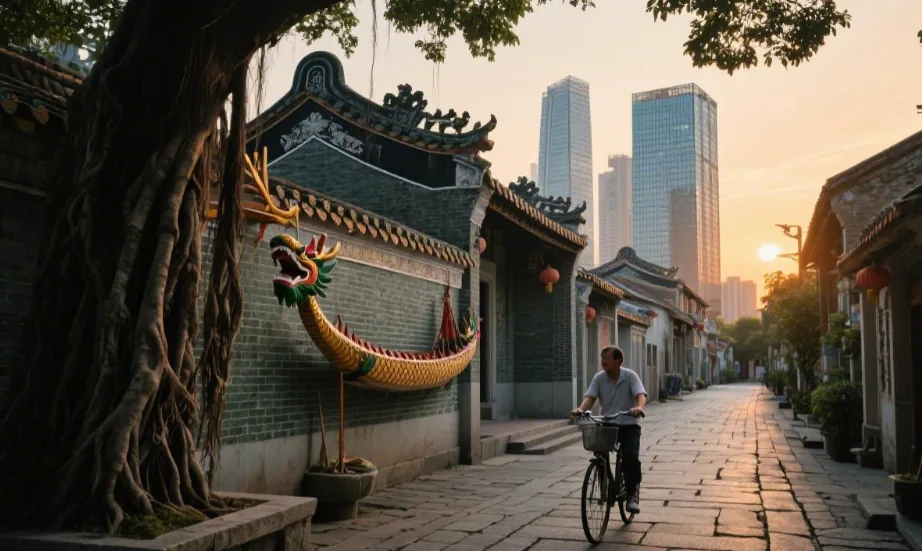
Day 3: Tiyu Xi Hengjie is Best for Eating While Walking
By Day 3, I’ll switch my focus from “gradually understanding a whole neighborhood” to “repeatedly observing a single horizontal street.” Comparing Tiyu Xi Hengjie with Tianhe Nan 1st Road, the difference is clear. Tianhe Nan 1st Road feels like a smooth route for gradual unfolding; Tiyu Xi Hengjie is more like a high-density area where the road isn’t as expansive, but content is packed closer together. Because of this, it’s better for frequent stops. You don’t need to keep rushing; walking just dozens of meters and stopping often reveals a new layer of content.
I’ll start near Tiyu Xilu station to keep things simple. This area is already a very convenient point for walking and transferring in Tianhe. After exiting, you can quickly connect the main road, the horizontal street, and the surrounding backstreets. By Day 3, you’re no longer in that “just arrived” state, so it’s a good time for detailed viewing without needing a long warm-up on big roads. I usually walk a short bit along the main road after exiting to check the day’s vibe before cutting into the entrance of Tiyu Xi Hengjie.
- I won’t aim to walk a long distance today, prioritizing the frequency of stops instead.
- Check the storefront density at the entrance first; don’t rush to buy things.
- Day 3 is a good time to turn off mobile navigation later and walk by “street feel.”
- If you’ve stayed near Tiyu Xi or Shipaiqiao for the first two days, heading out today will be effortless.
| Time | How I Walk | What I Primarily Look For |
|---|---|---|
| Around 10:00 | Start near Tiyu Xilu station | Watch the switch between main street speed and the horizontal street entrance |
| Around 10:20 | Enter the Tiyu Xi Hengjie entrance section | Observe storefront density and pedestrian lingering |
| 11:00 to 13:00 | Slow walk along the middle section, arrange lunch | Observe daytime street structure and dining rhythm |
| 14:30 to 17:00 | Diffuse into surrounding backstreets | See how residential, office, and dining vibes mix |
| 18:00 to 21:00 | Return to the street for the night version | Watch lighting, crowds, seat occupancy, and the sense of lingering |
Tiyu Xi Hengjie is perfect for a full-day theme, not because it’s long, but because its internal changes are fast. On the main street, everyone walks noticeably faster—many are commuting, transferring, or running errands. Once you enter the horizontal street, the rhythm slows. People start looking at storefronts, stopping to chat, checking menus, or just waiting for friends. This state where “more people are stopping” is the biggest difference between Tiyu Xi Hengjie and Tianhe Nan 1st Road. The latter is for walking straight through; the former is for looking at it section by section.
I won’t eat too much at the entrance in the morning. At most, I’ll buy water or a small snack that won’t hinder my walking. The truly interesting parts of the Tiyu Xi Hengjie line are the middle section and backstreets. If you fill up at the start, your legs will feel heavy, and you’ll lose interest in further exploration. I’d rather save my appetite for lunch and dinner on Day 3. The morning is for understanding the daytime version of the street.
When walking Tiyu Xi Hengjie, I usually don’t sit down at the first nice-looking shop I see. I prefer to view the state of the entire first section before deciding where to stop. This ensures I don’t use up all my time in the first stretch and makes it easier to tell which places are actually good for sitting versus which just have nice storefronts.
From late morning through lunch, I’ll advance slowly along the middle section. The middle of Tiyu Xi Hengjie is worth observing because it shows that a horizontal street isn’t just a small road; it has its own rhythm. Storefront brightness is different during the day than at night, of course, but you’ll find it easier to judge which shops are truly serving local life versus those aimed at instant consumption. You’ll also notice that daytime lingering points are clearly distributed: in some sections, people naturally slow down; in others, they just pass through. These details are more useful in an article than simply saying “there are many shops.”
For me, the focus of Tiyu Xi Hengjie during the day isn’t eating but observing its street structure. Some storefronts on both sides are very close, one after another, creating a visually compact feel; other spots open up suddenly, giving you a chance to breathe. The street isn’t as wide as a main road but doesn’t feel suffocatingly narrow. Walking here, you clearly feel it’s a street where people live, work, and pass through long-term, not just a place that gets busy on weekends. Because of this, its state is stable and doesn’t rely on holidays.
- The day is for seeing the middle section first; no need to head to the deepest parts immediately.
- When you find a section where “more people are stopping,” pause for a few minutes to observe.
- Don’t treat this street as a pure dining line; it’s a slice of urban daily life.
- Glance at the horizontal branch roads when passing intersections; you’ll likely use them in the afternoon.
I’ll have lunch near the street without detouring far for a specific shop. The reason is simple: the focus of Day 3 is maintaining the reality of “eating while walking.” If you go too far off-line for a meal, the “street feel” will break. For me, lunch is a pause in the middle of the day to rest my feet and let my brain organize what I just saw.
I usually schedule lunch between 11:30 and 13:00, adjusting based on how crowded the street is. If I eat too early, the morning observation isn’t complete; eat too late, and afternoon stamina will drop. When sitting for lunch, I try to pick a spot where I can see the street—not necessarily facing the intersection, but where I can feel the rhythm outside. The most valuable thing about Tiyu Xi Hengjie is that the street continues to provide content even while you’re seated.
| How I Choose My Lunch Spot | Selection Logic |
|---|---|
| Near the main line of the horizontal street | Can continue walking immediately after eating |
| No long wait for a seat | Save stamina and time for the afternoon |
| Stable price per person | There’s still dinner and night spending on Day 3 |
| Comfortable seating | Seating experience is important on a day with many stops |
After noon, I won’t immediately re-walk the same section but will focus on the surrounding backstreets. After 14:30, the street state differs from the morning. People coming out from offices, local residents, and food hunters slowly mix together. Tiyu Xi Hengjie is dense enough, but its surrounding backstreets are what truly give it depth. Walking only the horizontal street itself is fun, but adding the backstreets helps you understand why it’s worth a full day.
Among these backstreets, some are more like the edges of residential areas with smaller shops and lower noise; others suddenly turn into dense dining zones where crowds increase. You’ll find that the Tiyu Xi area isn’t uniform—multiple uses are squeezed together without being completely chaotic. Some people are working, some are eating, some are passing through, and some are just browsing. This mix feels fresh for first-timers and provides great detail for writing.
The best part of Tiyu Xi Hengjie in the afternoon isn’t a single point, but the process of turning from the horizontal street into a backstreet and then looping back. In this process, street width, noise levels, and shop density all change, and the people walking follow suit. Just walking one loop will naturally form a clear street map in your mind.
Toward evening, I’ll return to Tiyu Xi Hengjie once more. This return is very necessary because it truly has two different states during the day and night. During the day, you see the street skeleton; at night, you see street vitality. Once it gets dark, street-side seats fill up, storefront brightness rises, and lingering people outnumber those just passing through. You’ll find that sections that seemed like ordinary passages during the day suddenly become very attractive at night. It hasn’t turned into a completely different place, but its inherent density is magnified at night.
I’ll have dinner after dark, which is more worthwhile. The best time for dinner on Tiyu Xi Hengjie isn’t when the sun is strongest, nor late at night as it wraps up, but when the street has fully come alive but isn’t yet too congested. When you sit down then, a glance shows the street’s rhythm. People searching for shops, chatting while walking, or sitting still—the sense of lingering is more pronounced than during the day.
- Try to have dinner after dark, don’t settle it early.
- Nighttime is for sitting down, not for a frantic walk.
- If you spotted a nice road during the day, it’s best to walk it again at night.
- The real thing to see at night is the sense of lingering, not just the lights.
Regarding expenses, the easiest way to exceed the budget on Tiyu Xi Hengjie isn’t transport or tickets, but various small purchases. The issue isn’t one expensive meal, but the ease of “buying a little something.” Wanting a drink when seeing a shop, trying a snack while passing, or needing a supply when tired—exceeding the plan by 100 to 200 RMB is common. Therefore, I intentionally space out my consumption rhythm. Only buy water and essentials in the morning, sit for full meals at noon and night, and try not to fragment other spending.
| Item | What I Usually Budget |
|---|---|
| Metro and short-distance transport | 15 to 30 RMB |
| Full meals | 80 to 150 RMB |
| Coffee, drinks, snacks | 40 to 80 RMB |
| Spontaneous additions | 50 RMB |
| Daily Total | 185 to 310 RMB |
I also view the day’s spending in two categories. One is “necessary for the route,” such as transport, full meals, and water; the other is “street-induced,” like sitting for a drink, buying snacks, or spontaneous shopping. Separating these two makes it easier to tell if Tiyu Xi Hengjie is for you. Some like this high-density experience of spending while walking and find it very worthwhile; others prefer a clear destination and might feel the spending is too scattered and hard to control.
For me, the most interesting part of Day 3 isn’t “what I ate,” but that I finally saw a horizontal street in its entirety, day and night. The day shows how it catches nearby office and local life; the night shows how it boosts the sense of lingering. Tiyu Xi Hengjie is good for eating while walking not just because there’s a lot of food, but because it gives many reasons to “stop for a bit.” You won’t be constantly pushed forward here; instead, you naturally slow down. For Citywalk, this kind of street is more durable for walking and writing than places where you just take a photo and leave.
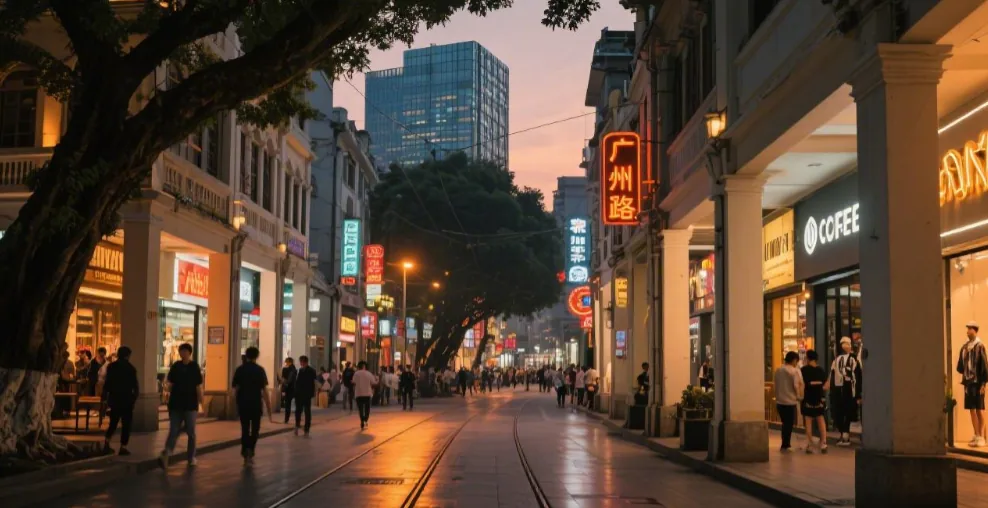
Day 4: From Zhujiang New Town into Liede Village
On Day 4, I won’t head out early like in previous days; I’ll save my primary time for the afternoon. More accurately, I usually start toward Liede Village after 15:30. The reason isn’t that you can’t see it during the day, but that the most valuable part of the Liede route is seeing it alongside Zhujiang New Town—the contrast is incredibly stark. One moment you’re in a space with wide roads, skyscrapers, glass curtains, and tidy office plazas; a little further ahead, the road suddenly narrows, the distance between buildings shortens, and your line of sight is no longer stretched far, causing you to naturally slow down. this change is most noticeable at dusk when light begins to slant, and the brightness of Zhujiang New Town exists alongside the shadows of Liede’s alleys.
I usually don’t describe Liede Village as a “perfectly preserved old village.” That’s inaccurate. It’s more like a renovated village living space that retains a part of the old alley rhythm and residential feel. That’s exactly why it’s worth seeing. In one of the most prosperous areas of Guangzhou, you see a living structure that hasn’t been completely swallowed by malls and office buildings. Writing it as perfectly preserved would be misleading, but calling it just another urban village would also be wrong. Its most special trait is the side-by-side existence of new and old, within walking distance.
- I’ll set the starting point at Liede Station today, not entering from a distant point.
- Upon arrival, don’t rush into the village; first, observe the relationship between the perimeter roads and the skyscrapers.
- Liede Village is best explored by walking the main alley first, then looking at residential streets, and finally wrapping up at the riverside.
- Day 4 is more about seeing “spatial changes” rather than a pure food route.
| Time | My Arrangement | What I Focus On |
|---|---|---|
| Around 15:30 | Depart from Liede Station | Let the pace transition from the metro to ground walking |
| Around 16:00 | Observe the village entrance and surrounding skyscraper relationship | See how Zhujiang New Town and Liede Village press against each other |
| 16:30 to 18:00 | Enter the main alley and residential streets | Look at alley scales, residential feel, and shop distribution |
| 18:00 to 19:00 | Dinner and a short rest | Save stamina for the evening walk |
| After 19:00 until 21:30 | Head toward the riverside, ending with night views | Observe nighttime light, switching between the riverside and the village |
When I exit Liede Station, the first thing I do isn’t looking for the alley entrance but standing on the perimeter to look around. This is necessary because the most interesting thing about Liede isn’t what you see inside, but the difference between “before entering” and “after entering.” The road scale on the Zhujiang New Town side is large, with open intersections, tall buildings, long sightlines, and people moving with clear purposes. Standing there, your pace naturally quickens. But once you turn toward Liede Village, the rhythm shifts. It’s not the forced slowness of a tourist spot, but the space itself compelling you to slow down.
This feeling is very specific. On the Zhujiang New Town side, looking up, lines are straight, glass reflects strongly, and the roadside order is complete; at the Liede entrance, sightlines begin to be fragmented by building bodies and corners, the road surface has more information, and there are more people lingering. People are standing and talking, sitting at doors, or moving in and out of small shops. Life here isn’t a display for tourists, so it feels more natural. For Citywalk articles, this content is important because readers want to know what they’ll actually encounter, not official PR.
Every time I walk Liede, my favorite part isn’t a fixed point but standing outside for a few minutes after exiting the metro. You realize very intuitively that these aren’t two separate areas but two completely different urban rhythms pressed tightly together. Once this switch is clear, the entire route becomes much easier to write.
After 16:00, I start toward the main alley of the village. I usually don’t change this order because rushing to the riverside first makes it easy to only remember the night view, missing the content-rich part of Liede. The main alley and residential streets are the core of this line. Walking inside, you see it’s not a “historic street” meant for photos, but a living space that’s still functioning. Shops aren’t neatly lined up for tourists—storefront sizes vary, and road widths change quickly. You’ll find some spots are just passages for residents, while others suddenly become busier.
I walk the main alley section slowly, especially the first 30 minutes. Not because navigation is hard, but because it requires patience. Liede’s content doesn’t pop out all at once; it unfolds in layers. When you first enter, you might just think it’s “different from outside”; walk another ten minutes, and you’ll realize the rhythm here truly is separate from Zhujiang New Town. People no longer pass through in straight, fast lines—they stop, give way, and loop around. The sound is no longer large-scale traffic and wind, but the fragmented, ground-level noise of urban daily life.
- Don’t rush to take many photos upon entering; let your eyes adjust to the spatial change.
- The main alley is worth a slow walk; don’t just dash through.
- Feel free to take a shallow entry into interesting small roads, you don’t have to walk them all to the end.
- This section is better for observing the relationship between people and space, rather than looking for a “tourist attraction feel.”
A part of Liede Village that leaves a deep impression on me is the speed at which spatial scale changes. The large roads outside make people walk fast; the small alleys inside make people slow down automatically—this isn’t an adjective, your body responds immediately. In Zhujiang New Town, your gaze can travel far, and walking is like a straight-line advance; inside Liede, the forward view is cut by corners and buildings, and you naturally notice near-distance details like feet, intersections, and doorways. This change itself is full of content. When writing, as long as you make the “wide and narrow,” “far and near,” “fast and slow” specific, the picture emerges.
Around 18:00, I’ll find a place to sit for dinner in or near the village. I won’t make this meal overly complex or travel far for it. The focus of Day 4 isn’t a dedicated food map but seeing the nighttime version of Liede in its entirety. So if you’ve already walked for over an hour in the afternoon, it’s best to sit and let your feet and attention rest. I prefer a dining location that is “near the main line but not in the most crowded spot,” so I can continue the original route afterward without a break.
| How I Choose My Dinner Spot | Reason for the Arrangement |
|---|---|
| Near the main alley or perimeter main line | No detour needed after eating; maintains rhythm |
| Can sit for 40 minutes to an hour | Evening roads deserve saved stamina |
| Avoid the most popular spots | Focus of Day 4 is walking, not queuing |
| Cost kept within normal range | There will be night supplies and transport costs today |
I head toward the riverside only after dinner. this order is important: village first, then riverside, which is more complete than doing it the other way around. The riverside itself easily steals all the attention, especially when lights come on at night; many might only remember the openness of the Pearl River, forgetting that Liede’s most interesting part is “tightening first, then opening up.” Walking out from the village alleys toward the riverside, your vision suddenly opens, the wind becomes more noticeable, and the ground-level life from earlier contrasts with the more expansive night view, creating layers.
Walking this section after 19:00, I pay special attention to lighting changes. Once the skyscrapers of Zhujiang New Town light up, a strong contrast forms with the perimeter and riverside of Liede. The alleys are warmer and lower; the lights and lines on the buildings are another system entirely. There’s no need for much sentimentality; just describe the relationships you see. For example, walking out of an alley, the front is a brighter, more open area; looking back, the village roads have darkened, but the sense of local life at the entrance is more pronounced. Such details are practical because readers immediately know what to look for on-site.
I rarely treat Liede Village as a “view at a certain point”; I treat it as a walking route with great variety. The first half is about ground-level life and alley rhythms; the second half is about openness, lights, and the nighttime urban surface. Together, they form the truly complete look of Day 4.
If you’re still staying near Tiyu Xi or Shipaiqiao, I think it’s perfectly fine—even better. You’ve been active in central Tianhe for the first few days; moving the range toward Liede on Day 4 won’t feel repetitive or like a tiring transfer. Especially since Day 4 starts in the afternoon, you don’t have to rush out in the morning, and staying in Tiyu Xi allows for more rest during the day, making the whole rhythm more comfortable. Returning isn’t complex either; the line from Liede back to Tiyu Xi at night is short and acceptable for someone who’s been walking for several days.
I usually view the spending on Day 4 as simpler than previous days because there are no tickets or complex activities. Primary costs are round-trip transport, dinner, and a few drinks or supplies. What truly affects the experience isn’t how much you spend, but whether you’ve timed things right. The Liede Village line is most susceptible to two mistakes: one is walking under the noon heat, which flattens the spatial layers; the other is heading straight for the riverside, missing the content of the village. The former makes you feel only hot and tired; the latter leaves you only with the night view, which can feel empty in writing.
| Typical Day 4 Expenses | How I Usually Control Them |
|---|---|
| Metro and short-distance transport | 10 to 25 RMB |
| Dinner | 60 to 120 RMB |
| Water and drinks | 20 to 40 RMB |
| Temporary supplies | 20 to 50 RMB |
| Daily Total | 110 to 235 RMB |
In Liede Village tonight, what I value most isn’t “how much I walked,” but whether I truly experienced the rapidly switching urban feelings. Zhujiang New Town is wide, bright, and fast; Liede Village is narrow, near, and slow—these differences are remembered by the body faster than the mind once you walk them. Ending at the riverside at night makes you feel that today wasn’t just about seeing one place, but about seeing how different layers of Guangzhou’s central urban surface and interior stack together. Such a route is perfect for Day 4 because you’re already familiar with central Tianhe, making the Liede experience feel complete.
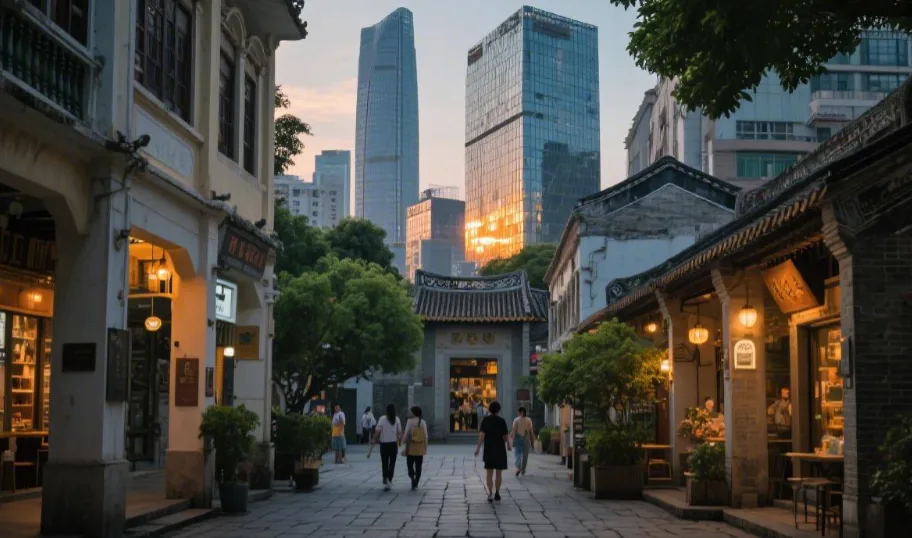
Day 5: Connecting the Three Neighborhoods Again
On Day 5, I won’t start a brand-new route. Instead, I’ll reconnect the three neighborhoods I’ve walked in the previous days, turning it into a “review” line for filling in the gaps. By the last day of a Citywalk, the reality is usually that you haven’t seen everything perfectly over the first four days. Specific thoughts linger: “I walked that section too fast,” “I only saw the surface of that intersection,” “I saw that horizontal street during the day but didn’t go back at night,” or “That section was pleasant, but I lacked the stamina to go deeper.” Day 5 is for these places. The content produced this way feels more like experience gained from a real walk rather than a mechanically pieced-together itinerary.
I usually set the departure time around 14:00, not too early. The focus of Day 5 isn’t racing against time, but stabilizing the final segment of the experience. After walking a lot in Tianhe over the last four days, starting in the morning on Day 5 can easily turn it into a purely physical chore. Heading out later has two benefits: avoiding the peak noon heat and leaving the nighttime for Liede Village. I’d rather leave the finale of the last day to the evening than to exhaustion.
- Day 5 is better for “re-visiting,” not for “catch-up rushing.”
- No need to head out too early; save your stamina for the evening and night.
- The walking method can be more subjective today; prioritize returning to places you felt most strongly about.
- The route doesn’t need to be comprehensive; only walk the segments truly worth a second look.
| Time | Route | What I Primarily Do in This Segment |
|---|---|---|
| Around 14:00 to 15:30 | Tianhe Nan 1st Road (South Section) | Re-walk the most pleasant streetscapes; look for missed details |
| 15:30 to 17:30 | Tiyu Xi Hengjie Short Line | Fill in gaps from horizontal sections; grab light food or drinks |
| 17:30 to 18:30 | Transfer and Rest | Save stamina for Liede at night; let the pace slow down |
| After 18:30 until around 20:30 | Liede Village Wrap-up | Use the night to complete the final experience and anchor the route |
I usually return to the south section of Tianhe Nan 1st Road first. Not because it’s the busiest, but because it’s the best opener for Day 5. After walking back and forth for several days, you already have a basic feel for this neighborhood. You know which section is easiest to walk, which intersection is worth a stop, and which side street isn’t worth a deep dive. On the last day, you won’t want to see everything like on Day 2; you’ll have a clearer idea of exactly what you want to see again. This state is important as it determines that Day 5 is “re-viewing after filtering,” not “repeating.”
The south section of Tianhe Nan 1st Road is good for this opening because its streetscape is stable. Street width, shop density, and roadside lingering points all belong to a smoother type. The first time you walked it, you might have just felt comfortable; returning for the second time, you’ll start to notice finer details. For instance, which section has more layers in the afternoon than at night, where more people stop, or which side street entrance looks ordinary but leads to a quieter area. This is why Day 5 writing is good—you’re no longer talking about “what this street is like,” but “why I’m willing to come back and walk it again after seeing it once.”
When I return to the south section of Tianhe Nan 1st Road on the last day, my most prominent feeling isn’t freshness but familiarity. Familiarity isn’t boring; it makes it easier to tell which sections were just “okay” the first time and which are truly durable for walking. A street that doesn’t feel empty on a second visit proves it has real content.
I won’t walk this section too fast. Although the route is familiar, the biggest danger of Day 5 is rushing because of that familiarity. The real value is picking up content you ignored at first glance. For example, lighting changes during the day on the same street, the sense of distance between storefronts, traces of shop updates, or the state of people sitting in street-side seats—you might not see all of these on your first pass. On the last day, because you’re not in a hurry, it’s easier to truly see them.
When cutting from the south section of Tianhe Nan 1st Road to Tiyu Xi Hengjie, I usually don’t walk the entire horizontal street again. Having seen its day and night versions on Day 3, a full repeat on Day 5 would be repetitive and tiring. My approach is to walk only the small area I felt most strongly about. It might be a specific middle segment, a connection between an entrance and a backstreet, or a place where I didn’t sit down during the day, specifically returning to sit for a while this time. The Tiyu Xi Hengjie that emerges this way feels more like personal experience than a template route.
On Day 5 in Tiyu Xi Hengjie, I value “stopping” and “selecting” more. Day 3 was for looking while walking; Day 5 is for filtering while reflecting. You’ll clearly find that some places were lively the first time but don’t pull you to stop on a return visit; however, other places you just passed by on Day 3 are ones you still want to slow down for on Day 5. This difference is very helpful for readers. What’s truly worth recommending isn’t just a place that makes a first impression, but the segment you remember and want to return to after several days.
- Tiyu Xi Hengjie doesn’t need a full re-walk on Day 5; pick the small segment you liked most.
- Better for filling in fragments you didn’t see fully during the day or night earlier.
- If you’ve had a formal meal there in previous days, this segment can be lighter.
- The last day in the horizontal street is better for sitting for a while, not for constant buying and walking.
| How I handle the Tianhe Nan 1st Road and Tiyu Xi Hengjie segments on Day 5 | Practical Consideration |
|---|---|
| Walk the Tianhe Nan 1st Road south section more completely | This line is good for a steady start on the last day |
| Only pick a small segment of Tiyu Xi Hengjie to re-walk | Avoid repetition; stay closer to a real trip experience |
| Arrange a short rest in between | Save stamina for Liede Village in the evening and night |
| Don’t overfill on food and drinks | Prevents losing the desire to keep walking later |
Around 17:30, I usually slow down intentionally and don’t rush to Liede Village immediately. A common mistake on Day 5 is thinking, “It’s the last day, let’s cram in more.” But this usually leads to a poor finish. A more practical way is to leave time for a transfer and rest after finishing Tiyu Xi Hengjie. You can sit briefly, hydrate, organize photos, or just rest your feet. Day 5’s Liede Village isn’t a normal transfer; it’s the finale of the entire route, and if you’ve already exhausted your stamina, the final experience will be noticeably duller.
I head toward Liede Village again around 18:30, leaving the final segment to the night. Having walked the full sunset line of Liede on Day 4, there’s no need to repeat all the main alleys inside the village on Day 5. Treat it instead as a “memory point wrap-up.” That is, going to Liede this time isn’t to get to know it again, but to let the Citywalk end at its most layered spot. Tianhe Nan 1st Road provides smoothness, Tiyu Xi Hengjie provides density, and Liede Village provides a sense of memory through spatial switching. Ending the walk here anchors the entire line.
Visiting Liede Village again on Day 5, I care most about “whether I still have a reaction when I return here.” If the answer is yes, it means this place truly withstands a second look. Once the high-rises of Zhujiang New Town light up, walking toward the village edge and riverside brings back all the feelings accumulated over the previous days. You’ll remember being in that “rhythm-finding” state on Day 1, and the “constant stopping” street feel of Day 3 on Tiyu Xi Hengjie. These feelings are gathered together on this final night in Liede. Not because it’s the most spectacular, but because it most easily connects all the previous days.
I put the finish line at Liede Village on the last day not to see the “scenery” again, but to let the three rhythms I’ve walked for 5 days meet in my mind. The smoothness of Tianhe Nan 1st Road, the density of Tiyu Xi Hengjie, and the side-by-side existence of new and old in Liede Village become very clear on the final night.
Day 5 is also the best time to write about “which segment I recommend most.” In the first few days, the novelty magnifies everything, and everything seems worthwhile; by the last day, you can better distinguish what was just new at first sight from what truly stands up to a second look. In my experience, Tianhe Nan 1st Road is better for relaxed walking, good for easing into a rhythm and establishing direction for first-timers; Tiyu Xi Hengjie is better for stopping and eating, as its content comes from density, not length; Liede Village is best as a final memory point because its spatial contrast is the greatest, making it a perfect end for the article.
There’s no one-size-fits-all here. Many like to rank these places when writing routes, but these three neighborhoods are more like three different rhythms. Tianhe Nan 1st Road is for slowly getting into the zone, Tiyu Xi Hengjie is for boosting the sense of lingering, and Liede Village is for opening up urban layers all at once. Connecting them again on Day 5 is meaningful because you finally stop seeing them as three isolated names and understand the role each plays in the same route.
In terms of expenses, Day 5 usually isn’t as prone to fragmented spending as Day 3, nor does it involve walking for as long as Day 2. It’s a “wrap-up” type of spending, generally very controllable. Mostly transport, simple supplies, dinner, and a few drinks. What truly affects the experience is still stamina and rhythm. If you over-walk the last day just to save a bit on transport, it can make the most important wrap-up segment feel flat.
| Typical Day 5 Expenses | What I Usually Budget |
|---|---|
| Metro and short-distance transport | 10 to 25 RMB |
| Afternoon light food or drinks | 20 to 50 RMB |
| Dinner | 60 to 120 RMB |
| Temporary supplies | 20 to 40 RMB |
| Daily Total | 110 to 235 RMB |
If your accommodation for the previous days was near Tiyu Xi or Shipaiqiao, Day 5 will be particularly smooth. Returning first to the familiar south section of Tianhe Nan 1st Road, then cutting into the short line of Tiyu Xi Hengjie, and finally wrapping up at Liede Village, there is no significant pressure from backtracking. You won’t feel like you have to “adapt to a new place again” today, nor will you lose your rhythm just because it’s the last day. A truly comfortable final day isn’t about having the most content, but about knowing why you are taking every step.
Related Reading
- 4-Day Family Trip to Guangzhou | Chimelong Safari Park + Birds Park + Guangdong Science Center, Stress-Free Guide for Parents
- Guangzhou 5-Day Lakeside Cycling Tour | Bio Island Greenway + Haizhu Lake + Baiyun Lake Park, The Most Beautiful Two-Wheel Route Through Urban Water Systems
- Guangzhou 4-Day Music & Theater Tour | Xinghai Concert Hall + Guangzhou Opera House + Friendship Theatre, A Visual & Auditory Journey of Elegant Art and Supreme Acoustics
- Guangzhou 5-Day Temple Zen Journey | Night View of Dafo Temple + Haizhuang Temple + Nengren Temple, A Tranquil Blessing Trip in a Bustling Metropolis
- 5-Day Lingnan Private Garden Tour in Guangzhou | Yuyin Shanfang + Baomo Garden, Immersively Experience Cantonese Carved Beams and Painted Rafters